


If you ask Claude Code for a landing page with nothing else to go on, it will make good decisions. They just won’t be yours. It has no idea what your product feels like, so it picks the safest version of everything. The fix isn’t a longer prompt. It’s a few small files the agent reads before it touches a component.
This is the setup I use and recommend. It takes about an hour if you already know what your brand is, and there’s a free template at the end. If you don’t know what your brand is yet, skip to the last section, because that’s the real problem. For the background on why this matters, see why Claude Code websites look the same.
What Claude Code actually reads
Claude Code loads CLAUDE.md files at the start of a session. The docs list four scopes: managed policy, your user folder, the project, and a local file you keep out of git.1 Files in folders above where you launched load right away. Files in subfolders load the first time Claude works in that folder.
Two lines from the same page are worth keeping in your head. First, Claude treats these files “as context, not enforced configuration.” It’s guidance, not a linter. Second, the docs suggest you “target under 200 lines per CLAUDE.md file.” The best-practices guide puts it more bluntly: every line costs attention on every task, so only write down what Claude can’t figure out from the code.2
A brand is exactly that kind of thing. Nothing in your package.json says your product is calm, or that your primary color is a specific red, or that you’d rather die than ship a purple gradient.
The four files
| File | What goes in it | Who reads it |
|---|---|---|
brand.md | Voice, words to avoid, color roles, type, imagery, layout rules | Claude, when doing frontend work |
brand.css | Design tokens as CSS variables (Tailwind @theme) | Your code, and Claude through the code |
public/brand/ | Logo, mascot, the mockup image | Claude when it needs a visual target |
CLAUDE.md | Two lines pointing at the above | Claude, every session |
You’ll find other names for the first one. Google Labs published an open format called DESIGN.md, described in its README as “a format specification for describing a visual identity to coding agents.”3 It pairs YAML tokens with Markdown prose and can export to Tailwind and the W3C token format. Kevin Riedl at Wavect describes a four-part setup with a reference file, CLAUDE.md, DESIGN.md and an examples folder.4 The name doesn’t matter. What matters is that the rules are written down once, in the repo, where the agent can find them.
1. brand.md: the part with opinions
Start with voice, because it’s the thing people forget and the thing that makes copy sound generated. The best public examples I know separate voice from tone. Mailchimp’s style guide puts it in one line: “You have the same voice all the time, but your tone changes.”5 Atlassian goes further and says when to turn each trait up or down, like being less bold with trial users and dropping the humor when someone hits an error.6
For an agent, the most useful lines are the ones it can check itself against. GOV.UK’s A to Z style guide is full of them: write cannot instead of can’t, use plain English, avoid a specific list of words.7 “Be friendly” is useless to a model. “Never use the words seamless, unlock or supercharge” is not.
brand.md (excerpt)
## Voice
- We sound like a senior engineer explaining something to a friend.
- Short sentences. Contractions are fine.
- Headlines: a concrete benefit, max 7 words, no question marks.
- Never use: revolutionize, seamless, unlock, supercharge, elevate.

## Color
Tokens live in src/app/brand.css. Use them, never raw hex.
- primary: buttons, links, one highlight per screen
- ink: text. paper: background. muted: secondary text and borders.
- Never: purple-to-blue gradients, glassmorphism, neon glows.

## Layout
- Hero: headline left, mascot right, one CTA.
- No emoji as icons. Max one gradient per page.
- Don't add sections that aren't in the mockup.
“Be friendly” is useless to a model. A list of banned words is not.
2. brand.css: tokens the code can’t ignore
Rules in Markdown are suggestions. Tokens in CSS are the path of least resistance. If the only colors that exist as utility classes are yours, Claude will use yours.
In Tailwind v4 that’s the @theme block. Variables you put there become utilities, so --color-primary gives you bg-primary and text-primary, and --color-*: initial wipes the default palette first.8 That last line is the important one. If bg-violet-600 doesn’t exist, nobody can reach for it.
src/app/brand.css
@import "tailwindcss";

@theme {
  --color-*: initial;
  --color-primary: #E92A24;
  --color-ink: #111111;
  --color-paper: #F6F1E8;
  --color-muted: #D8D3CC;
  --color-white: #FFFFFF;

  --font-display: "Space Grotesk", system-ui, sans-serif;
  --font-sans: "Manrope", system-ui, sans-serif;

  --radius-card: 12px;
}
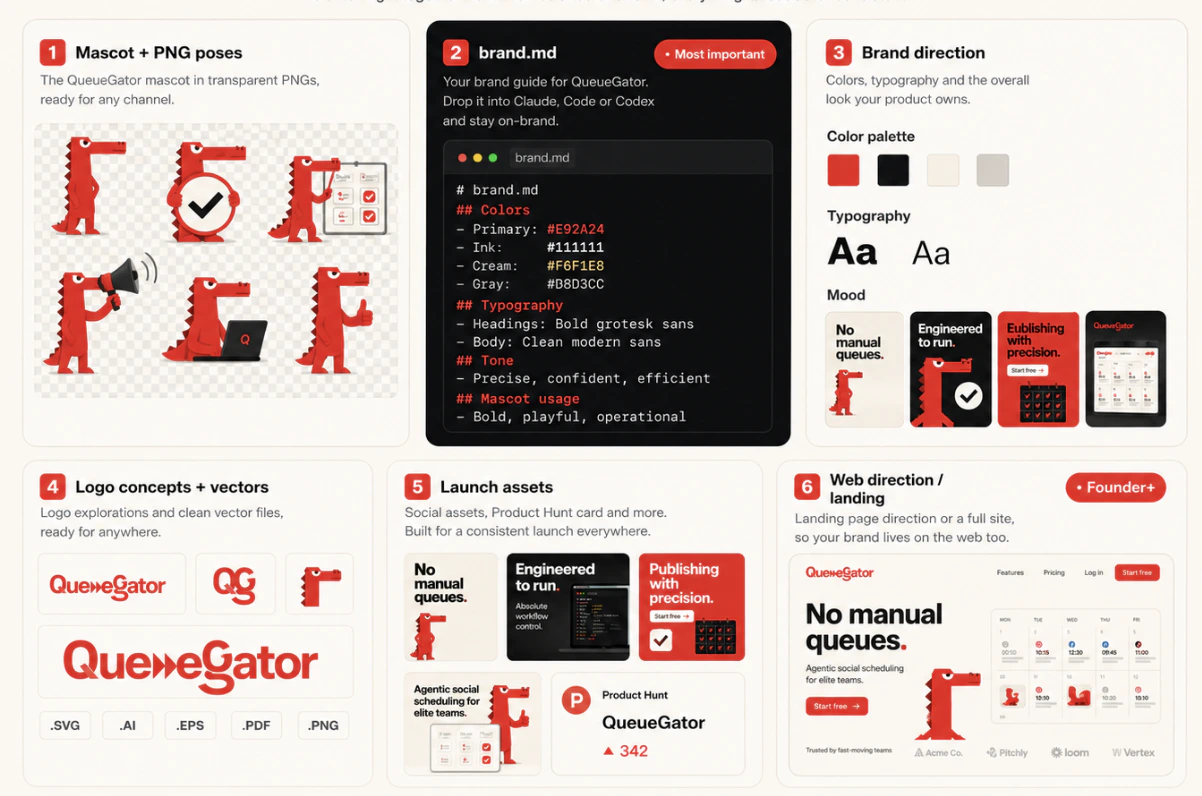
Those are QueueGator’s colors from the kit above, by the way, copied straight out of its brand.md. If you work with designers or several platforms, the same values can live in a W3C design tokens file. The Design Tokens Community Group published its first stable format, version 2025.10, on 28 October 2025.9 One detail that trips people up: dimensions are objects with a value and a unit, not strings like "8px".10
brand.tokens.json (DTCG 2025.10)
{
  "color": {
    "$type": "color",
    "primary": { "$value": { "colorSpace": "srgb", "components": [0.914, 0.165, 0.141], "hex": "#E92A24" } },
    "ink":     { "$value": { "colorSpace": "srgb", "components": [0.067, 0.067, 0.067], "hex": "#111111" } }
  },
  "radius": {
    "card": { "$type": "dimension", "$value": { "value": 12, "unit": "px" } }
  }
}
3. A picture beats a paragraph
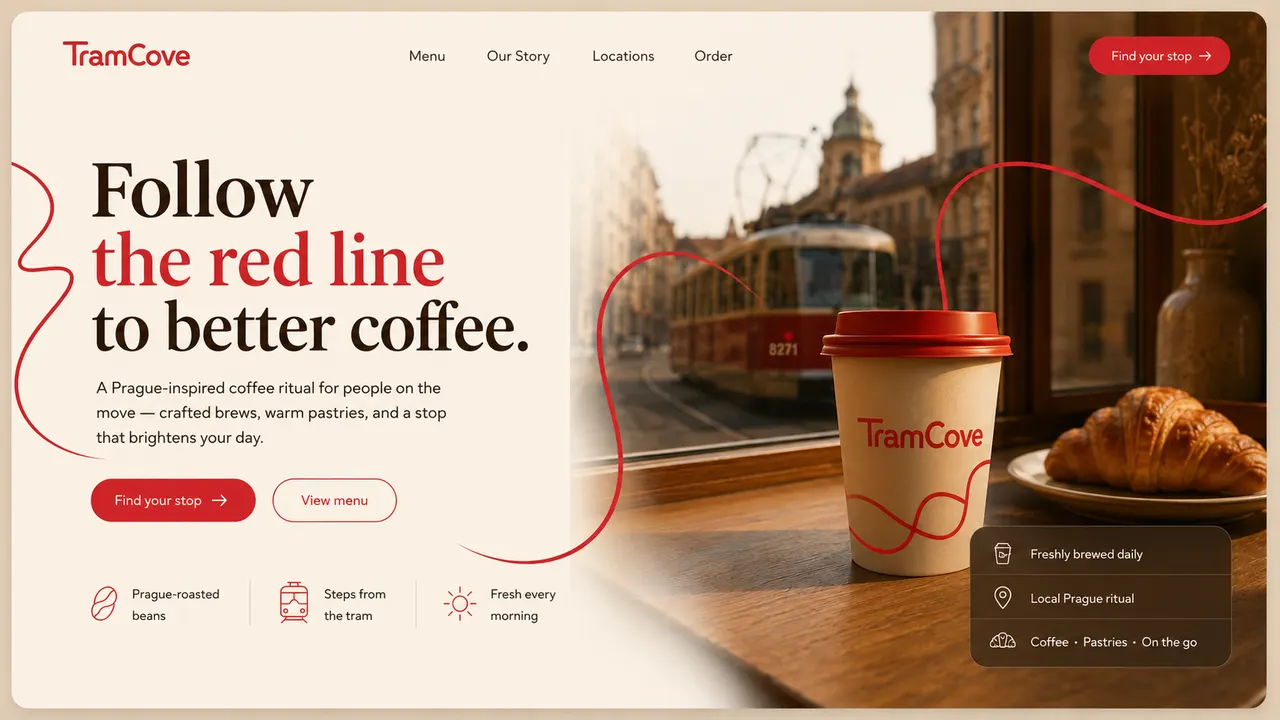
This is the step most setups skip, and it’s the one that changes the output the most. Anthropic’s own best-practices guide tells you to paste a screenshot of the design into the prompt, and lists comparing a browser screenshot against the mockup as a check Claude can run on its own work.2
Words like “warm” or “premium” mean a hundred different things. A mockup means one. Put it at public/brand/mockup.png, put the mascot and logo next to it, and tell Claude to match the mockup before it invents anything.
4. CLAUDE.md: just point at it
You could paste the whole brand guide into CLAUDE.md. Don’t. It would load on every task, including the ones about your database. Claude Code supports imports with @path, but the docs are clear that imports don’t reduce the context cost.1 The better option is a path-scoped rule in .claude/rules/, which only loads when Claude touches matching files. It also pairs well with Anthropic’s frontend-design skill.
.claude/rules/brand.md
---
paths:
  - "src/**/*.{tsx,jsx,css}"
---
Before any UI work, read brand.md and look at public/brand/mockup.png.
Use only the tokens in src/app/brand.css. Match the mockup before inventing.
CLAUDE.md (the only two lines you add)
## Brand
UI rules live in brand.md and .claude/rules/brand.md. Visual target: public/brand/mockup.png.The part a template can’t do
All of this assumes you know your colors, your type, your voice and what your mascot looks like. Most people starting a side project don’t. They have a working title, a product idea, and a placeholder logo made of their initials in a circle.
If that’s you, filling in the template will produce a very tidy description of nothing in particular. You’ll write “modern, clean, friendly” and get the same site as everyone else, just with more files.
That gap is why I’m building Monstric. It runs inside Claude Code as an MCP, and before any code it gives you a name with an available .com, a few distinct brand directions to pick from, the assets, and a designed mockup. Then it writes the brand.md, the tokens and the mockup into your repo, which is exactly the setup above. It’s on a waitlist while I finish it. You can see brand kits it has made, try the brand builder, or read the FAQ.
But you don’t need it to start. Pick a real color, a real typeface and three banned words today. It will already look less like everyone else’s.
Ready to meet your brand?
Describe your business in one sentence and see a free preview of your brand on a website header. Sign in with Google or email to generate it.
Sources
- How Claude remembers your project (CLAUDE.md and memory), Claude Code docs, Anthropic
- Best practices for Claude Code, Claude Code docs, Anthropic
- DESIGN.md, Google Labs on GitHub
- Claude Code Design System: 4 Parts for On-Brand UI, Kevin Riedl, Wavect, 2 Sep 2026
- Voice and Tone, Mailchimp Content Style Guide
- Voice and tone, Atlassian Design System
- A to Z style guide, GOV.UK, Government Digital Service
- Theme variables, Tailwind CSS v4 docs
- Design Tokens specification reaches first stable version, W3C Design Tokens Community Group, 28 Oct 2025
- Design Tokens Format Module 2025.10, Design Tokens Community Group