



Let me get this out of the way, since I’m building something adjacent: if you use Claude Code for anything with a UI, install Anthropic’s frontend-design skill. It’s free, it’s good, and the latest version is a lot smarter than most of the blog posts about it suggest. It also has a limit that no amount of prompting fixes, and that limit is worth understanding.
What it is
Frontend-design is a Claude Code skill, a Markdown file of instructions that Claude loads when it’s about to build interface work. You can install it as a plugin, and the plugin page showed 1,134,112 installs when I looked on 10 November 2026.1 Anthropic introduced it in November 2025 in a post that explained the problem it was meant to solve: left alone, models drift to the “high-probability center” of web design, and the result “makes AI-generated interfaces immediately recognizable.”2 I wrote about the wider pattern in why Claude Code websites look the same.
It changed a lot, and most write-ups missed it
If you read a review of the skill from last winter, it probably said it bans Inter and purple gradients. That was true. The December 2025 version told Claude to avoid Inter, Roboto, Arial and system fonts, to avoid “purple gradients on white backgrounds,” and to commit to a bold direction from a menu running from “brutally minimal” to “maximalist chaos.” It also nudged toward gradient meshes, noise and grain.3
The version in the repo today, last updated on 3 September 2026, reads very differently.4 It doesn’t name a single banned font. Instead it describes five clusters of design that it calls “defaults rather than choices,” including:
- a cream background with a serif display face and a terracotta accent,
- near-black with one acid green or vermilion accent,
- a “broadsheet” look with hairline rules and dense columns,
- the SaaS card kit, identical rounded cards with a soft shadow and gradient washes,
- and template chrome: all-caps eyebrows, arrows appended to links, monospace labels.
The first one is my favorite detail in the whole file. The terracotta it flags, #D97757, is Claude’s own brand accent. The skill is effectively telling Claude not to make your site look like Claude.
The old skill banned a look. The new one bans the idea of a default.
What it gets right
The rewrite is less a style guide and more a process, and the process is solid. In short, it asks Claude to:
- Pin down the subject, the audience and the job of the page. If the brief doesn’t say, propose one and confirm it.
- Write a token plan first: four to six named hex colors, the typefaces and their roles, and a layout sketched as an ASCII wireframe.
- Review that plan against the brief, revise anything generic, and say what changed.
- Only then write code, and check it with screenshots.
It also has a quality floor that a lot of human-built sites miss: visible focus states, reduced motion, accessible contrast, responsive layout. And there’s good copy advice, like writing “Save changes” instead of “Submit.” If you’ve never worked with a designer, this file teaches you more about how one thinks than most courses.
What it can’t do
Read the skill closely and you’ll notice it works one brief at a time. Every time you ask for a page, it invents a fresh palette and type plan from what you told it. That’s the right design for a general-purpose skill. It’s also the limit.
Three things are missing, and they’re missing on purpose, because they’re not the skill’s job:
- A name. It will build a gorgeous page for “My App.” Choosing a name, and one with a domain you can actually register, happens before design.
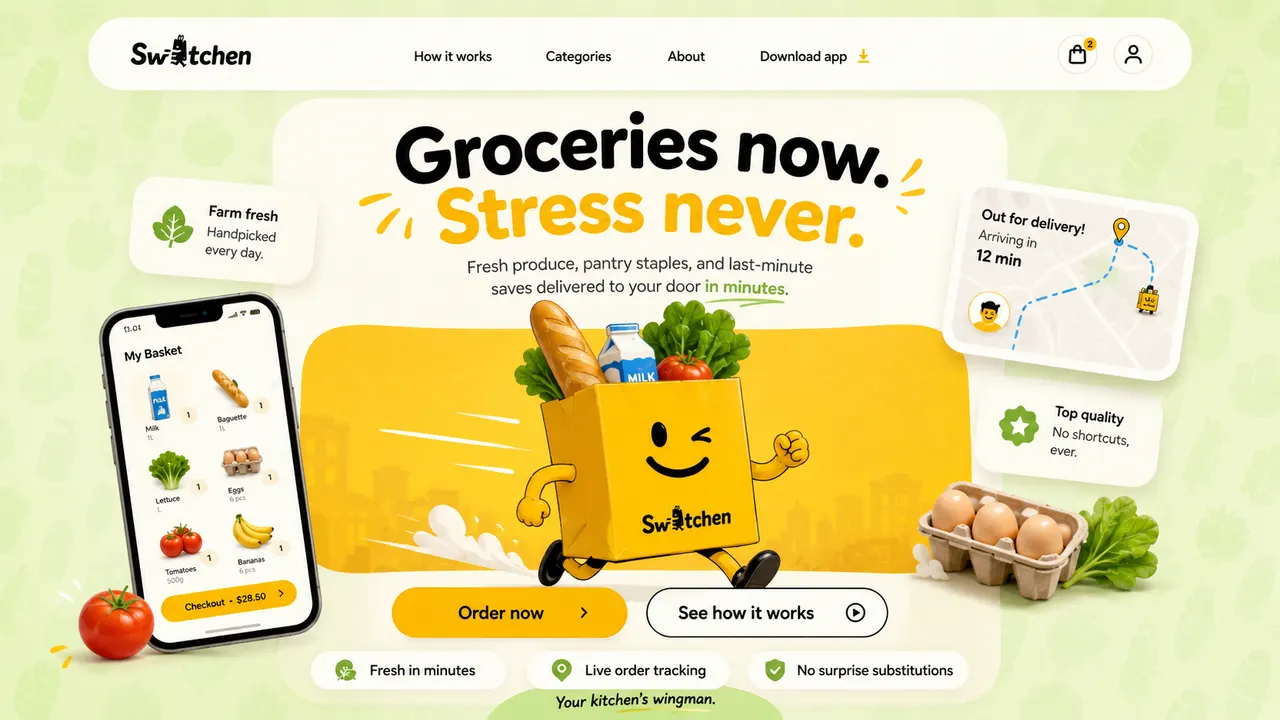
- Assets. It writes code. It doesn’t produce a logo, a mascot, photography or a hero image. Without them, even a perfect layout has to lean on type and shapes alone.
- Memory. The palette it picks for your landing page isn’t saved anywhere as your brand. Ask for the pricing page next week and you may get a different, equally tasteful direction. The skill mentions using memory of the client’s preferences as a hint, and that’s about it.
Anthropic seems to see this too. The same launch post suggests teams write their own skills to encode their company’s design system.2 Which is great advice, if you have a design system. A solo founder on day one usually has a product idea and a working title.
| frontend-design skill | Your own brand files | Monstric | |
|---|---|---|---|
| Design process and quality floor | Yes | No | Uses the skill's ideas too |
| Picks a palette and type | Per brief, fresh each time | You decide once | You pick from directions |
| Name with an available .com | No | No | Yes |
| Logo, mascot, hero image | No | If you have them | Yes |
| Designed mockup to match | No | If you have one | Yes |
| Persists across pages and sessions | No | Yes, in the repo | Yes, in the repo |
| Price | Free | Your time | Waitlist |
How to use both
The skill and a brand aren’t competitors. The skill is a process that starts from a brief. Give it a brief that already contains your brand and it gets much better, because its first step, the token plan, has real answers instead of guesses.
The setup I’d recommend: install the skill from its plugin page, or run /plugin inside Claude Code and search for frontend-design. Then add one path-scoped rule that tells it where your brand lives.
.claude/rules/brand.md
---
paths:
  - "src/**/*.{tsx,jsx,css}"
---
This project has a brand. When the frontend-design skill asks for a token plan,
take it from brand.md and src/app/brand.css instead of inventing one.
Match public/brand/mockup.png before proposing layout changes.
If you don’t have brand.md yet, I wrote a guide with a free template: how to give Claude Code a brand before it writes code. And if the blank template is the problem, that’s the gap Monstric fills. It runs inside Claude Code, gives you a name with an available .com, a handful of distinct directions to pick from, the assets and a mockup, and writes the brand files into your repo. Then the skill takes over and does what it’s good at. You can see some brand kits and websites built with Monstric, try the brand builder, or read about Monstric for indie makers and agencies.
The skill makes Claude a better designer. It can’t make Claude your client. Somebody still has to say what the brand is, and it’s much better if that somebody is you.
Ready to meet your brand?
Describe your business in one sentence and see a free preview of your brand on a website header. Sign in with Google or email to generate it.
Sources
- Frontend Design plugin, Claude plugins, Anthropic, install count read 10 Nov 2026
- Improving frontend design through Skills, Claude blog, Anthropic, 12 Nov 2025
- frontend-design SKILL.md, December 2025 version, anthropics/skills on GitHub
- frontend-design SKILL.md, current version (updated 3 Sep 2026), anthropics/skills on GitHub
Skill contents described as of the 3 September 2026 commit. It changes often, so check the repo for the latest version. I couldn’t confirm which commit the plugin itself currently ships.